The National Standard for Organic and Biodynamic Produce is Australia’s technical export
standard for organic and bio-dynamic goods. It is given effect through Australia’s export
regulatory framework for organic goods intended for export. The National Standard may also
be used voluntarily by producers supplying the domestic market who wish to market their
goods as meeting the Standard.
Chapter 6 of the National Standard (Edition 3.8, 2015, last updated 2022) apparently
regulates raw or bulk imported organic produce, because it may be repackaged or further
processed and recertified to carry a logo from a DAFF approved Australian organic
Certification Body and be re-exported from Australia. Some confusion about organic claims
on imported goods arises from branded products (jams, sauces etc.) that cannot be
excluded from imports because of WTO rules. Article 3 of GATT relates to national treatment
and requires that imported goods should not be subject to discrimination when compared to
locally produced goods. In other words, countries may not impose more restrictive standards
for imported goods. This means that in the absence of a domestic regulation, Australia is
prevented from banning the import of produce labelled with a foreign organic label. To
attempt such a limitation would be perceived at a trade restriction, until such time as the ban
can be established based on a consistent export and domestic regulation.
This implies that, if there are no legally-binding domestic standards, any imports
labelled as organic – and produced in whatever way – can be legally imported and
called ‘organic’. It can be safely assumed that neither the government nor the organic
industry is interested in making the domestic organic industry uncompetitive in this
way. (Wynen and Clay, 2018).
The most frequently encountered foreign label is the USDA organic seal. USDA NOP allows
hydroponic production and some different inputs such as soluble mined Sodium Nitrate.
Most organic standards around the world prohibit hydroponic production, and consumer
organisations in the USA have mounted a strong challenge to the standard to again prohibit
organic hydroponics. Canada includes a clause in their equivalence agreement with the USA
that excludes hydroponic methods for NOP certified goods imported into Canada. Domestic
Australian organic regulation could similarly protect local consumers from this production
method and require a conformity assessment process for imported organic produce before it
could be sold in Australia. That is, specified production methods may be excluded from
mutual recognition arrangements. Any proposed Australian domestic organic regulation
should require a comprehensive side-by-side standards comparison and analysis prior to
agreeing to equivalency arrangements with other country regimes. Such arrangements
commonly include exclusions for certain categories of product that are not compliant with
local standards.
The status of imported certified organic products in November 2026
Industry rumours suggest that some imported bulk products are fumigated upon entry but
still make their way into organic markets (pers. comms. with organic traders and government
biosecurity officers, 2016 and 2019), in contradiction to clause 6.1.6. There are imported
processed products that display certification marks from other countries, but there is no
effective control on those products. Without standards equivalence agreements in place
between Australian and other countries, consumers cannot be sure that imported products
comply with the National Standard.
Although the Competition and Consumer Act of 2010 should apply to imported product, and
would be applied to such products if they did not meet safety standards, in the absence of
domestic regulation, it is unlikely that authorities can effectively deal with organic claims on
imported products where they are not compliant with the National Standard and they would
only come to the attention of authorities if they are reported by Australian certification bodies
or consumers.
Chapter 6 of the National Standard is exemplary of problems in drafting the standard, in the
absence of domestic regulation. Chapter 6 deals only with raw or bulk produce. Clause
6.1.1. is not explicit that the standard does not control domestic products bearing a label
from another country, but it is the interpretation of authorities responsible for managing
movement of produce through the wharf (or airfield).
6.1.1 Organic or bio-dynamic produce which is imported into Australia can be labelled
as meeting this Standard provided the produce satisfies the following requirements:
a. a competent authority and/or government approved certification organisation has
issued export documentation; stating the consignment has been produced under a
system that is equivalent to this Standard; or
b. the certification organisation is recognised by the importing country competent
authority; and
c. was subject to a regular system of inspection by a competent authority approved
certification organisation; and
d. does not contain any substances not permitted by this Standard.
(National Standard Edition 3.8)
The extract above is unchanged since Edition 1. The original drafters knew that the standard
did not apply to the domestic market but believed that it would be adopted into legislation in
some form, as stated by Minister Kerin when he announced the establishment of OPAC in
1990. The intention for the standard to apply to the domestic market was repeated by
Minister Crean when he launched the standard in 1992, and by AQIS officers Erwin and
Lovisolo on numerous public platforms (some are listed at Appendix 4). The intent of the
OPAC committee (which drafted edition 1) for Chapter 6 of the National Standard was to
deal with produce entering the country that might be subject to further processing and
labelling, or otherwise exported again.
Clause 6.1.2. could leave the uniformed (common) reader with the view that the National
Standard has legal force in the domestic market when it does not. Its application is limited to
produce that will be re-exported.
6.1.2 Imported organic or bio-dynamic produce can be labelled as meeting this
Standard provided that the operator (importer) is certified and the imported products
comply with 6.1.1.
Additionally, Clauses 6.1.3 and 6.1.4. relate to an export certificate issued by a competent
authority or government approved certification body in another country, and 6.1.6 refers to
exclusion of product treated with a fumigant at the wharf.
6.1.6 Following any pre or post entry quarantine chemical or ionising radiation
treatments an operator must not label imported organic or bio-dynamic produce as
meeting this Standard. In these situations all organic or bio-dynamic trade descriptions
must be either de-faced or stencilled-over or destroyed.
Organic Consumers Association of Australia (OCAA) investigations and personal
communication with biosecurity staff during normal industry business suggests that imported
product is sometimes not inspected by biosecurity officers, or when fumigated, no action is
taken to ensure that in does not continue to be part of the organic chain of custody.
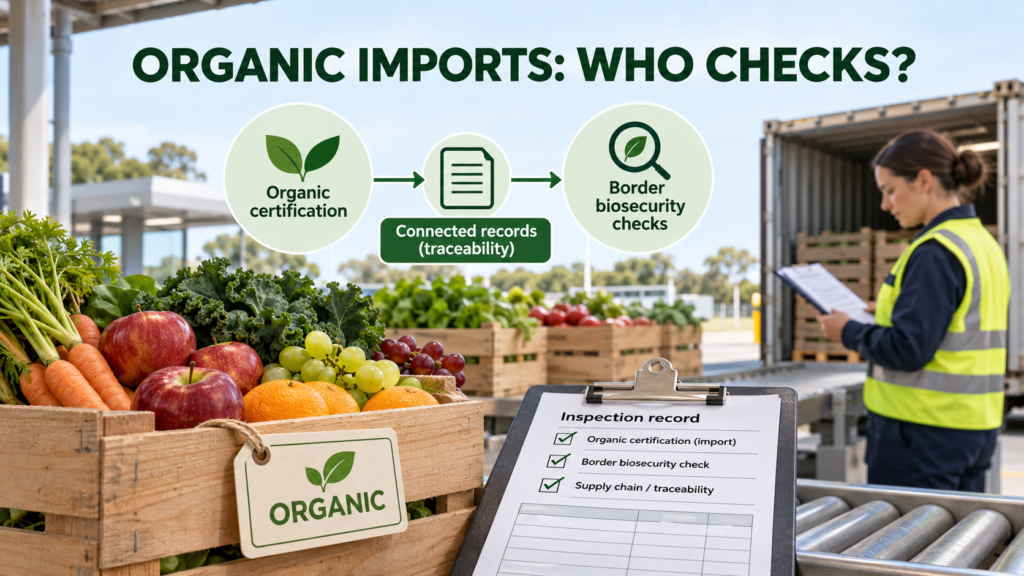
Certification bodies could ensure beyond doubt that non-compliant produce is not labelled as
organic if they insist that in each case of imported produce, the wharf-side documentation
relevant to treatment and handling of the consignment is provided to the certification office. It
is no longer a requirement that certification bodies insist upon (pers comms. with certification
officers from several certification bodies). Government accreditation audits of the certification
bodies relate to re-exported produce, consistent with the government position that it is not
responsible for domestic control.
Once again, consumers are left without any certainty that the very large quantity of imported
produce that is either repackaged or processed and labelled with an Australian organic logo,
is genuinely in conformity with the organic standards (whichever one they bear in the retail
space). OCAA asks, is this the certification cabal at work to protect traders and certification
fees rather than genuine consumer interests? The solution is straightforward: inspect every
consignment and insist that clearance certifications for each consignment are provided to the
certification body and acted upon.
Wynen, E., & Clay, L. (2018, February). Roadmap for Australia’s organic industry: A legal
domestic standard. Paper circulated to Australian Organic Industry Working Group by the
authors prior to the Love Organic meeting in Canberra.