Organic farming builds soil carbon—and can help crops through drought
A consistent finding across the research is that organic systems accumulate more soil organic carbon (SOC) than comparable conventional systems. The size of the difference varies with soil, climate, rotations and trial length, but the overall direction is strongly supported by the evidence. pmc.ncbi.nlm.nih.gov
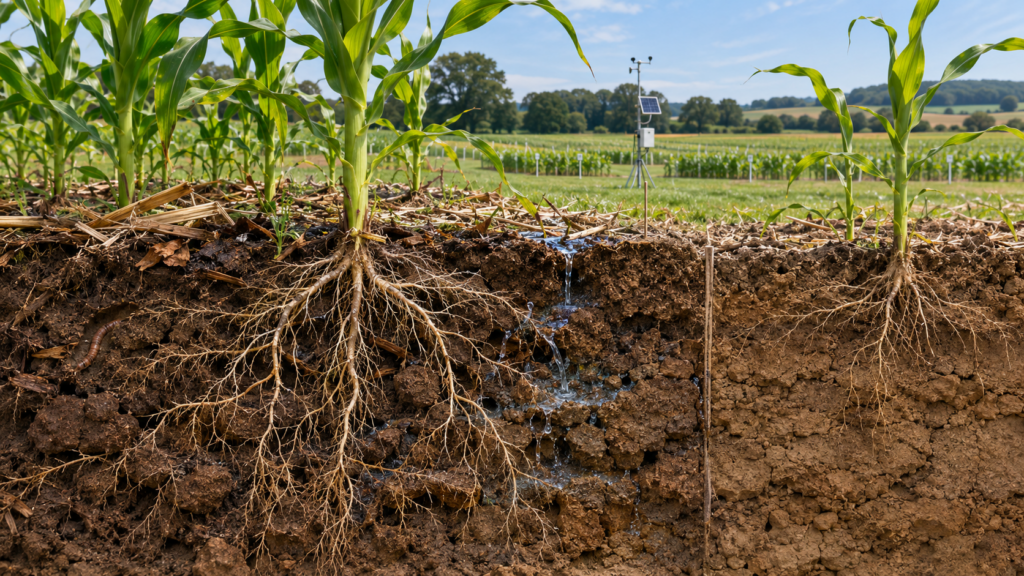
Why does this matter? Soil carbon is part of the foundation of healthy soil. It helps support soil structure and stable aggregates, which can improve infiltration and help soil retain water for plants. These relationships are well established and give us a clear reason to care about the carbon content of agricultural soils.
The long-running Rodale Farming Systems Trial offers a striking example of how these soil benefits may matter in difficult seasons. In five drought years, corn yields in its organic systems were reported to be 28–34% higher than in the conventional comparison. That result shows what can happen in a particular long-term trial—and points to the potential value of soil-building practices when water is scarce. www.nationalacademies.org
Together, the findings support three important points:
• Organic systems can build higher soil carbon stocks.
• Some long-term organic systems have achieved higher yields in drought years.
• Soil structure, aggregation, infiltration and water retention offer a plausible pathway connecting soil health with crop resilience.
The open research question is how much each part of that pathway contributes to yield outcomes, and how consistently the results apply across different soils, climates and farming systems.
That question does not erase what the evidence already shows. It helps identify the next step: long-term studies that measure soil carbon, water movement and crop performance together, so we can better understand how soil-building translates into resilience in the field.
The positive case is clear: investing in soil organic carbon is an investment in the capacity of agricultural soils to function, recover and support crops under pressure.
Sources: Gattinger et al. (2012), Enhanced top soil carbon stocks under organic farming; Zhao et al. (2024), Sustainability; Lotter et al. (2003), Rodale Farming Systems Trial.